

Home » Programs » PHP Treatment » What to Expect in PHP
If you’re starting PHP soon, or helping someone who is, a PHP day looks a lot like a full workday spent in treatment: you arrive in the morning, spend most of the day in groups and one-on-one sessions, and go home at night. Our partial hospitalization program is the most structured outpatient care we offer, for adults working through mental health concerns, substance use, or both.
Knowing the shape of the day ahead of time can make the first morning easier. Most people’s nerves center on the same few questions: how long the day is, whether they’ll have to talk in group, and what happens with work.
PHP at Strength Recovery Services runs for several hours a day, on several days each week, and our admissions team can give you the exact schedule before you start. Across the country, partial hospitalization programs generally provide 20 or more hours of treatment each week (1), which is why the schedule tends to feel closer to a job than to a weekly therapy appointment.
Many PHP days start with a short check-in, where the group talks through how the night went and what each person wants to work on that day. From there, most of the day is spent in group sessions, with individual time with your clinician fit in around them. The schedule typically includes a midday break and shorter breaks between groups, so you aren’t sitting in sessions for hours without a pause.
The mix shifts as your treatment plan takes shape. Early on, more of your time tends to go to assessment and getting settled; later, more of it goes to practicing skills you’ll use once the program ends.
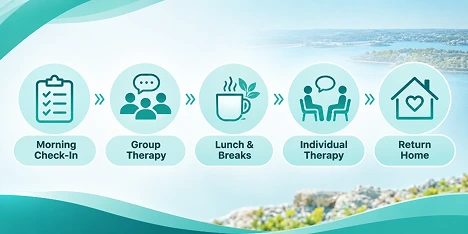
Most of your PHP day is spent in small groups of adults, each led by a clinician. Groups at Strength draw on approaches that are part of our PHP treatment plans:
If you’re nervous about talking in front of strangers, you’re in good company. Most people start by listening, and you decide how much personal detail to share as you get comfortable with the group. Listening still counts as taking part, and many people find it easier to speak once they’ve heard others describe something close to their own experience.
You’ll also meet regularly with your own clinician for individual therapy. These sessions are where you can bring up what you don’t want to say in group, such as a relationship that’s falling apart, a slip over the weekend, or a worry about going back to work.
Your clinician also works with you on your treatment plan, which sets out the goals you’re working toward and the parts of the program that support them. The plan is reviewed regularly and adjusted as things change, so it reflects where you are now rather than where you started.
Family can be part of treatment too. Family therapy gives partners, parents, or other relatives a guided space to talk through what’s happened at home and how to support recovery without taking it over. If you’d like family involved, let your clinician know so sessions can be planned around your treatment schedule.
The first week is mostly about getting to know you. Your clinician completes an assessment that looks at your substance use, mental health, physical health, and home life, and the two of you use it to build your first treatment plan. It’s normal for this week to feel tiring; a full day of treatment is a big change from your usual routine.
In the middle weeks, the work gets more specific. You’ll spend less time on introductions and more on practicing skills, then trying them at home in the evenings and talking through what happened the next day. Your plan shifts as you go, based on what’s working and what isn’t.
As things become more stable, the next step is often moving into our intensive outpatient program, which covers fewer hours each day so you can take back more of your regular schedule. You can read more about what to expect in IOP. After IOP, our aftercare program can continue with counseling, relapse prevention, and family support.
There’s no set number of weeks for PHP. How long you stay depends on your needs and how your treatment is going, and your clinician will talk with you about timing well before any change.
Most people can’t keep a regular full-time job during PHP, because the program fills the hours you’d normally be at work. Many take time off instead. The federal Family and Medical Leave Act (FMLA) may let eligible employees take job-protected leave for substance use treatment from a health care provider, and family members may be able to use it to care for someone in treatment (2). Whether it applies depends on your employer and your situation, so check with HR. If your employer asks for documentation, let our team know early so there’s time to sort it out.
Getting here is the other daily logistic. Our facility is at 1221 Main Street in Weymouth. If getting here each day is a concern, mention it on your first call so our admissions team can talk through options with you.
Evenings, and any days you aren’t scheduled, are yours, and they’re part of the work. Going home each night means you practice new skills in the same places and with the same people you’ll be around after treatment ends. If an evening goes badly, that becomes something to bring to group the next morning, not a reason to give up on the program.
On your first day, bring:
Before your first day, ask our admissions team if there’s anything you shouldn’t bring. A notebook can help too. Many people find it useful to jot down a skill from group or a question for their clinician before the day gets away from them.
It’s worth checking your coverage before day one, so cost isn’t a question hanging over your first week. Insurance may help cover PHP when it’s medically necessary, but benefits vary by plan. Our admissions team can verify your insurance and walk you through what your plan is likely to cover.
If you’re still deciding whether PHP is the right level of care, the assessment helps answer that. You don’t need to figure it out on your own before you reach out.
Usually not full time. PHP takes up most of the weekday, so many people take leave while they’re in the program. If keeping your job hours is a must, our intensive outpatient program leaves more room for work, and an assessment can show which level of care fits.
No. You can listen until you’re ready to talk, and you decide how much of your story to share. Clinicians lead each group and keep it focused and respectful.
It varies. PHP length is based on your needs and progress rather than a fixed number of weeks, and your clinician will talk with you about stepping down to IOP when the time is right.
PHP at Strength Recovery Services is based at our Weymouth facility. Virtual options may be available in some situations, so ask our admissions team whether that’s possible for you.
Call (339) 201-3448 to ask about start dates, the daily schedule, or anything on this page you’d like explained before your first day. If you’d rather start online, verify your insurance and our admissions team will follow up with what your plan covers.
If you or someone you love is in crisis or thinking about suicide, call or text 988, or call 911.