

Home » Therapy » Relapse Prevention Therapy » Relapse Prevention Plan
If you’re finishing PHP or IOP, or helping someone who is, a relapse prevention plan is the part of treatment you take home with you. It’s a short written document, not a feeling or a promise to try harder. It lists what tends to set you off, the early signs that things are slipping, what you’ll do about each one, and who you’ll call. Our relapse prevention therapy helps you build it during treatment, and it’s meant to be shared with the people named on it.
The plans that get used tend to be specific. “Reach out more” is hard to act on at 9 p.m. on a bad Friday; “text my sponsor before I leave work on payday” isn’t.
A working plan covers five things, and none of them needs to be long:
Most plans fit on a single page. A plan that runs longer tends to get skimmed or left in a drawer, and you want something you can read in under a minute when you’re already struggling.
Relapse usually builds gradually, often over weeks or months, before someone picks up a drink or drug. Addiction physician Steven Melemis describes it in three stages: emotional, mental, and physical. Your plan works best when it targets the first two, since the final moment before using is the hardest place to stop (1).
Stage | What it can look like | What your plan can do |
Emotional | You aren’t thinking about using, but you’re bottling things up, isolating, skipping meetings or going without saying anything, and eating or sleeping poorly | List your self-care basics and check them daily, especially when you’re hungry, angry, lonely, or tired (HALT) |
Mental | Part of you wants to use and part doesn’t: cravings, thinking about old people and places, remembering using as better than it was, or bargaining (“just on vacation”) | Name your bargaining lines ahead of time and say them out loud to someone on your plan |
Physical | Using again, often in a window when you think no one will find out | Plan exits for the moments you’ll be alone or unaccounted for |
The emotional stage is easy to miss because it doesn’t feel like a craving at all. In the stages Melemis describes, poor self-care is the common thread of emotional relapse, which is why a good plan includes ordinary things like meals and sleep.
The quickest way to find your triggers is to look back at the last few times you used or came close. Ask what was going on right before: who you were with, where you were, what time it was, and how you felt. Patterns tend to show up fast. It might be the drive home past a bar you used to go to, Sunday afternoons with nothing planned, a phone call with a particular family member, or the days after a fight about money. Holidays and trips can be high-risk too, since they’re easy times to tell yourself the usual rules don’t apply (1).
Warning signs are different. They’re changes in you rather than in your surroundings: canceling plans, going quiet in group, staying up late, saying “I’m fine” when you’re not, or keeping a small secret from the people on your plan.
It also helps to know what isn’t a warning sign. Brief, passing thoughts about using are common in early recovery and don’t mean you’re failing. The signal to act on is when those thoughts start coming more often or feel more insistent than they did a week ago (1). Writing down when cravings show up for a week or two can make that change easier to spot.
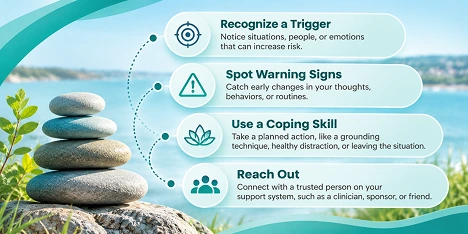
Your plan should name at least two or three people, so you’re never relying on one person who might not pick up. Melemis calls this a recovery circle: the family, counselors, doctors, sponsors, and self-help groups you can be completely honest with (1). For most people leaving PHP or IOP, that circle includes:
Aftercare can keep the clinical part of that circle in place. Our aftercare program includes continued individual and group counseling, peer support, and connections to local recovery groups and 12-step meetings, so your plan can name check-ins that are already on the calendar.
Asking someone to be on your plan works better when the request is specific. Try something like: “Can I call you when I’m having a hard night? And if you notice me skipping meetings or going quiet, will you ask me about it directly?” Then give them a copy, so they know your warning signs as well as you do.
You can start your plan with the fields below. The example entries show the level of detail that tends to work: specific enough that someone else could read your plan and know exactly what to do.
Field | Example entry |
My top triggers | Payday Fridays; the drive past my old bar; arguments about money |
My early warning signs | Skipping my Tuesday group; staying up past 1 a.m.; saying “I’m fine” when I’m not |
When I notice one, I will | Text my sponsor before I leave work; eat something; go to an evening meeting instead of going home alone |
People I’ll call, in order | My counselor: ___ · My sponsor: ___ · My sister: ___ |
If I slip | Tell one person on this list within 24 hours; call my counselor about adding support; don’t wait to see if it happens again |
Crisis and emergency numbers | 988 to call or text in a crisis; 911 for a medical emergency |
Next date I’ll review this plan | ___ |
Keep a copy on your phone and a paper copy somewhere you’ll see it, like your wallet or the fridge.
A slip doesn’t erase the progress you’ve made. Melemis describes setbacks as a normal part of progress, usually caused by coping skills or planning that weren’t strong enough yet, and both can be fixed. The bigger risk is all-or-nothing thinking, the sense that one drink means the whole effort is ruined, which can lead people to give up on recovery entirely (1).
What helps most is acting quickly and honestly. Tell one person on your plan, ideally within a day. Then look at what came before the slip with your counselor: which trigger or warning sign showed up, and where the plan didn’t hold. That answer becomes your next revision.
Sometimes a slip means you need more support for a while, not less. If slips are repeating, or cravings stay strong for days at a time, talk with your clinician about returning to our intensive outpatient program for more structure while you get steady again.
If you’ve been away from opioids for a while, your tolerance is likely lower than it was, so even an amount you used to take can cause an overdose. Massachusetts public health guidance recommends carrying naloxone, the medicine that can reverse an opioid overdose (2). If someone is unresponsive or not breathing, call 911. If you’re thinking about suicide or in crisis, call or text 988.
The best time to build your plan is while you’re still in PHP or IOP, not the week you finish. Drafting it early gives you time to test it against real evenings and weekends, then bring back what didn’t work to an individual session. Group can help too, since other members will often spot a trigger or a loophole you’ve talked yourself out of.
Review the plan with your clinician before each change in care, such as stepping down from PHP to IOP or moving into aftercare. If family is involved, a family session is a natural place to walk them through the parts that involve them.
If you’re not in treatment right now and want help building a plan, our admissions team can verify your insurance and talk through which level of care fits.
Whenever something changes. That includes stepping down to a lower level of care, starting a new job, moving, a change in a relationship, and any slip. Many people also put a regular review on their calendar, such as once a month in early recovery, so the plan keeps up with what’s actually going on.
Usually, yes, at least the parts that involve them. Family members can’t help with warning signs they don’t know about, and a copy tells them exactly what to look for and what you’ve asked them to do. You decide who sees the full plan, and a family therapy session can be a good place to share it.
No. Setbacks are a common part of recovery, and they usually point to skills or plans that need more work, not to a person who can’t recover (1). A slip is a reason to revise your plan and, if needed, add support for a while.
Call (339) 201-3448 to talk with our team about relapse prevention, aftercare, or adding support after a slip. If you’d rather start online, verify your insurance and our admissions team will follow up with what your plan covers.