

Home » Programs » IOP Treatment » What to Expect in IOP
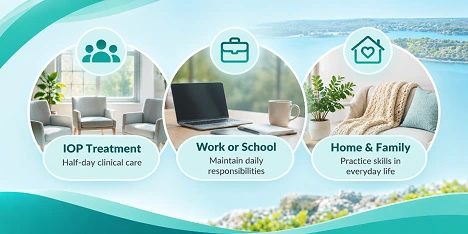
Whether you’re starting treatment for the first time, stepping down from PHP, or trying to hold on to your job while you get help, IOP is built to sit alongside the rest of your life. Our intensive outpatient program is a half-day level of outpatient care for adults working through mental health concerns, substance use, or both. You come in for part of the day, then go back to work, school, or home.
Most people’s first questions are practical ones: how many hours it takes, what happens in group, and whether they can keep working. The answers shape whether IOP fits your week, so they’re worth knowing before your first day.
IOP at Strength Recovery Services is a half-day program that meets on several days each week, which leaves the rest of the day for work, school, or family. Our admissions team can walk you through the current schedule before you start. Across the country, intensive outpatient programs for adults generally provide 9 to 19 hours of treatment each week (1).
Those hours are usually split between group sessions and individual time with your clinician. How many hours you attend can shift over time, since the schedule follows your treatment plan rather than a fixed template.
Even a half day can feel tiring at first, especially if you’re fitting it around a job or kids. Many people find it gets easier once the routine is set, and the hours outside the program become part of the work: the evenings and weekends are where you try out what you practiced in group.
Most of your time in IOP is spent in small groups, each led by a clinician. Groups draw on the approaches in our IOP treatment plans, including cognitive behavioral therapy (CBT), dialectical behavior therapy (DBT), relapse prevention, and holistic therapy.
Sessions vary, but many follow a similar pattern:
That last step is what makes IOP different from a weekly therapy appointment. You try something at home or at work, then bring back what happened, and the group helps you adjust.
If you’re new, you decide how much personal detail to share as you get comfortable. Group members are expected to respect each other’s privacy and keep what’s said in the room.
Alongside group, you’ll meet regularly with your own clinician for individual therapy. These sessions are the place for anything you’d rather not raise in group, from a slip over the weekend to stress about money or a relationship.
Your treatment plan starts with an assessment of where things stand now and sets short-term goals you and your clinician agree on. A goal might be as specific as getting through a work happy hour without drinking or going a week without skipping group. The plan is reviewed regularly and updated as life changes, whether that’s a new job schedule, a setback, or a goal you’ve already met.
Many people keep working or going to school during IOP, since the program takes up only part of the day. Fitting it in may mean shifting your hours on program days, using some paid time off, or asking for a temporary schedule change.
How much you tell your employer is up to you. Some people simply say they have a medical treatment schedule for the next several weeks. The federal Family and Medical Leave Act (FMLA) may let eligible employees take job-protected leave for substance use treatment from a health care provider (2). Whether it applies depends on your employer and your situation, so HR is the place to ask.
Family can be part of IOP too. Family therapy is one of the approaches in our treatment plans, and it gives partners, parents, or other relatives a guided space to talk about what’s been happening at home. If you’d like family involved, let your clinician know early so sessions can be planned around your schedule.
The move from PHP to IOP happens when you and your clinician agree you’re ready for less daily structure. That decision usually rests on how stable your symptoms or substance use feel, how well you’re using the skills you’ve practiced, and how much support you have at home.
The biggest change is time. PHP fills most of the day, while IOP is a half day, so you get back more hours for work and family while still coming in on several days each week. Many of the same approaches carry over, which helps the switch feel like a next step rather than a fresh start. If you’re still in PHP, you can read about what to expect in PHP.
When IOP ends, support usually steps down rather than stopping all at once. Our aftercare program can continue with counseling, relapse prevention, and family support as you return to your usual routine. It’s lighter than IOP, but it keeps you connected to counseling and peer support while you adjust to everyday life with less structure.
Before you finish, you’ll work on a relapse prevention plan that lists your warning signs, the people you’ll call, and what you’ll do in the situations most likely to test you. There’s no set number of weeks for IOP. How long you stay depends on your needs and progress, and your clinician will talk with you about timing before any change.
Often, yes. Because IOP is a half-day program, many people keep a full-time job by adjusting their hours on program days. Our admissions team can go over the schedule with you so you can see how it lines up with your work hours.
Yes. Some people begin directly in IOP, while others move into it after making progress in PHP. An assessment helps decide which starting point fits where you are right now, so you don’t have to choose on your own.
It varies. IOP length is based on your needs and progress rather than a fixed number of weeks, and your clinician will talk with you about stepping down to aftercare when the time is right.
Then your care can change. If symptoms or substance use become harder to manage, your clinician may recommend moving to our partial hospitalization program, which adds more hours of support each day. If you’re in crisis or thinking about suicide, call or text 988, or call 911.
Call (339) 201-3448 to ask about the current IOP schedule and how it would line up with your work or family commitments. If you’d rather start online, verify your insurance and our admissions team will follow up with what your plan covers.